50 Years of Delivering the Right Meal to the Right Member: What That Experience Means for Your Plan

Any company can say it delivers meals. Fifty years of doing it for the highest-need members in managed care is something different entirely.
Fifty years ago, GA Foods was founded on a belief that was straightforward then and remains foundational now: the right food, delivered to the right person at the right time, changes health outcomes.
What has changed over those five decades is everything around that belief. The clinical evidence base has grown into a recognized field of medicine. Federal and state policy has caught up to what the research has long supported. And the populations GA Foods serves have grown more complex, more clinically diverse, and more dependent on nutrition as a core component of their care.
For health plans evaluating medically tailored meal programs, the question is not whether nutrition intervention works. The evidence on that is settled. The question is who you trust to deliver it, at scale, reliably, for your highest-risk members. That is where fifty years of operational experience becomes the most relevant credential in the room.
What Gets Built Over 50 Years That Cannot Be Replicated Overnight
There is a version of a meal delivery program that almost any vendor can stand up quickly. Logistics partnerships, a rotating menu, a delivery window. What that version cannot deliver, and what fifty years of refinement produces, is something categorically different.
Clinical depth at the menu level
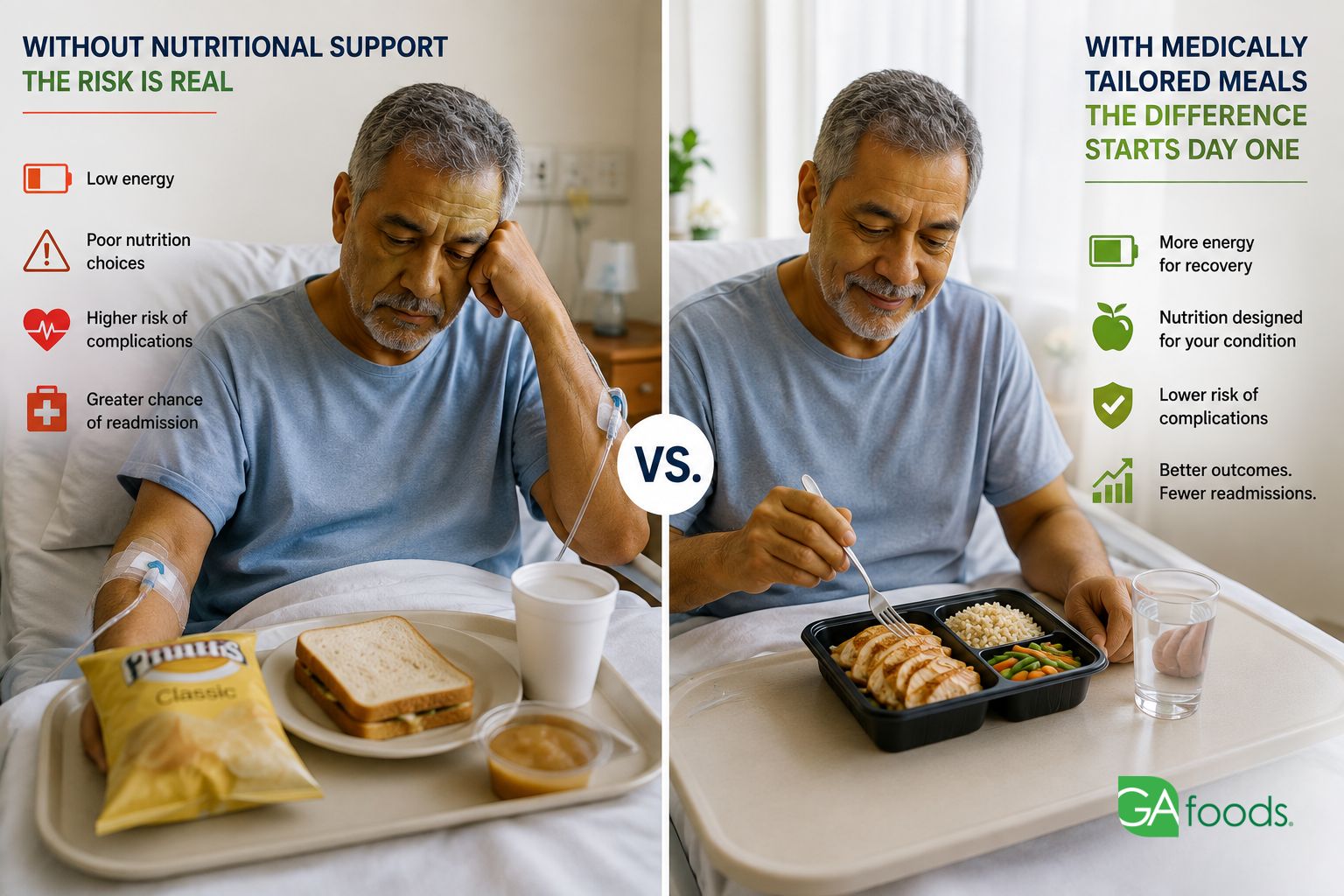
GA Foods employs registered dietitians who design condition-specific menus for the populations we serve. Heart failure. Type 2 diabetes. Chronic kidney disease. Oncology. Each condition has precise, non-negotiable dietary requirements that directly affect clinical outcomes. Sodium control for heart failure is not a preference. It is a clinical parameter with measurable consequences if it is wrong. Developing menus that are both clinically appropriate and acceptable to members, meaning members will actually eat them, is a discipline that takes years to refine. It requires understanding not just the clinical parameters but the cultural food preferences, portion expectations, and palatability standards of the populations being served. GA Foods has spent fifty years getting this right across diverse geographies and member populations.
A missed delivery is a missed intervention. Reliability is not a logistics metric. It is a clinical one.
Logistics infrastructure built for high-need populations
Delivering meals to homebound seniors, recently discharged hospital patients, and members with complex chronic conditions is operationally demanding in ways that standard food delivery is not. Members may have mobility limitations that affect how deliveries are received. They may live in rural or underserved areas where delivery windows are longer and more challenging. They may have no one at home to receive a delivery if the timing is off.
GA Foods has built its delivery infrastructure specifically for these populations. Our routing, our packaging, our delivery protocols, and our backup systems are designed around the reality of who our members are and what their lives look like. That infrastructure does not get built in a pilot year. It gets built over decades of learning what goes wrong and fixing it.
Care coordination that connects nutrition to the broader care plan
A meal program that operates in isolation from the rest of a member’s care is a meal program, not a care intervention. GA Foods works with health plan care management teams to ensure that our program is integrated into the member’s broader care plan, that delivery is confirmed, that member concerns are addressed, and that the plan’s team has visibility into program engagement.
This coordination capability is the difference between a vendor and a partner. It is also the capability that takes the longest to build, because it requires trust, process alignment, and relationship depth that only comes with time.
Fifty years of experience means fifty years of knowing what goes wrong and building systems that prevent it.
The Populations GA Foods Has Served
Over five decades, GA Foods has developed deep operational and clinical expertise serving the populations that managed care plans rely on us to reach.
Medicaid MCOs and Medwaiver programs
GA Foods has been a Medicaid partner since before managed care was the dominant model for Medicaid service delivery. We understand the authorization processes, the reporting requirements, the quality metrics, and the member population characteristics that define Medicaid managed care. Our programs are designed to work within Medicaid’s operational realities, not around them.
Medicare Advantage plans
As Medicare Advantage has grown and supplemental benefits have expanded, GA Foods has grown with it. We understand what MA plans need to demonstrate value to CMS, to their members, and to their employer and broker partners. Our programs are designed to contribute to HEDIS performance, member satisfaction, and total cost of care in ways that show up in the data.
LTSS and dual-eligible populations
Long-term services and supports populations and dual-eligible members represent some of the highest-need, highest-cost members in managed care. GA Foods has extensive experience serving these populations, including the coordination requirements that come with managing care across both Medicare and Medicaid funding streams.
What 50 Years Means for Your Plan Specifically
When a health plan partners with GA Foods, they are not taking a chance on a program that might work. They are activating a program that has already been refined across decades, populations, and states.
That means faster implementation, because our operational playbook is already written. It means fewer surprises, because we have already encountered and solved the problems that newer programs are still discovering. It means clinical confidence, because our menus and protocols have been reviewed, refined, and validated over thousands of member interactions.
And it means a partner who has seen the managed care landscape evolve from the outside and from the inside, who understands where policy is going before it gets there, and who has already built the infrastructure to deliver on what the Food is Medicine movement is asking health plans to do.
Fifty years is not a marketing number. It is the operational foundation on which every meal we deliver is built.

Digital Creative Specialist